
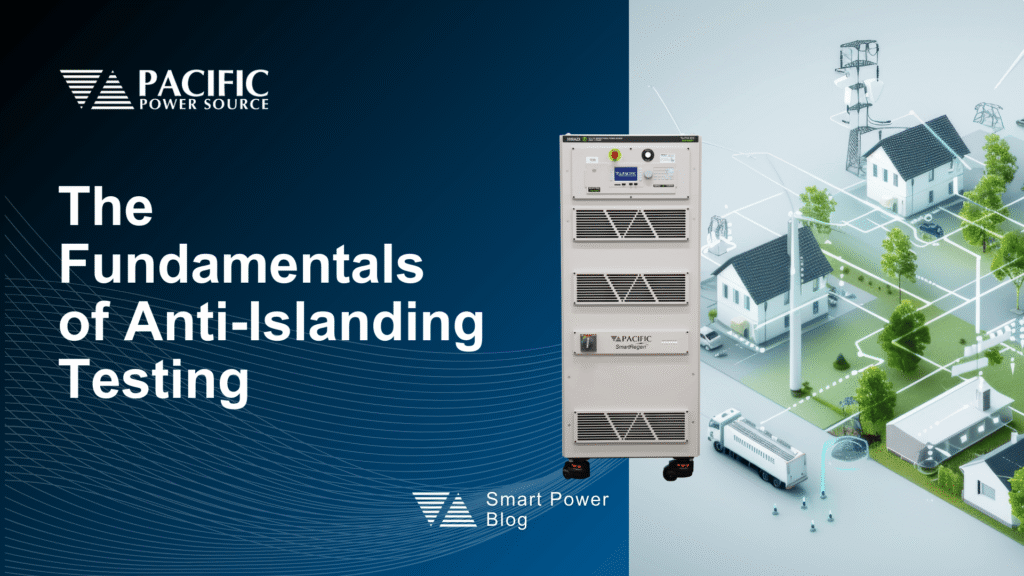
The Fundamentals of Anti-Islanding Testing

The Fundamentals of Anti-Islanding Testing

What is Anti-Islanding?

Anti-islanding protection is essential for distributed energy resources (DERs) like solar inverters, battery storage, and Vehicle-to-Grid (V2G) systems in which energy is pushed back onto the grid. Unintentional islanding poses safety risks, including hazards to utility workers, equipment damage, and service disruptions.

As the demand for distributed energy resources (DERs) and electrification grows, ensuring safety and grid stability has become more critical than ever. One of the key safety mechanisms is anti-islanding protection—designed to prevent a solar inverter, for example, from continuing to feed power onto the grid when the grid has shut down.

Islanding occurs when a local energy generator continues to feed power into the grid during a grid outage, creating a hazardous “island” of energized equipment. Anti-islanding protection ensures that DERs or grid connected systems like EV chargers promptly disconnect from the grid during such events, safeguarding utility workers, customers, and equipment.

Testing for anti-islanding behavior is a mandatory requirement in compliance with standards like UL 1741 SA and IEEE 1547.1. Pacific Power Source’s AZX and GSZ Series grid simulators simplify this complex testing by providing a controlled, repeatable, and automated test environment that meets industry requirements

Why Does Testing for Anti-Islanding Matter?

Regulatory standards require grid connected devices to detect and shut down during grid loss scenarios within a specified time.
Traditional anti-islanding tests involve precise control of voltage, frequency, and phase imbalance.

The main objectives of anti-islanding include:

  • Protect utility personnel from unexpected live circuits.
  • Prevent damage to grid connected equipment due to voltage/frequency mismatch.
  • Comply with interconnection standards (IEEE 1547, IEC 62116, UL 1741 SA, SB) and relevant regional interconnection codes.

Key Applications 

Anti-islanding testing is mandatory for DERs that export power to the grid such as:

  • Solar PV Inverters
  • Bidirectional EV Chargers
  • Battery Energy Storage Systems (BESS)
  • Vehicle-to-Grid (V2G) / Vehicle-to-Everything (V2X) Systems
  • Microgrids with Grid-Tied Modes
  • Smart Inverters / Advanced Grid Support Inverters

Example Grid Simulator Unintentional Islanding Test Configuration

A typical anti-islanding test setup is designed to evaluate whether a grid-tied inverter or distributed energy resource (DER) can reliably detect and respond to a loss of grid connection—an event known as unintentional islanding.

A Typical Anti-Islanding Set-up

  • Grid simulator
  • A device under test (DUT)
  • Controllable RLC load bank
  • Measurement equipment

Together, these components replicate real-world scenarios in which the inverter must cease to energize an isolated section of the grid. This controlled environment allows for precise assessment of the inverter’s anti-islanding protection capabilities, as required by standards such as IEEE 1547, UL 1741, and IEC 62116.
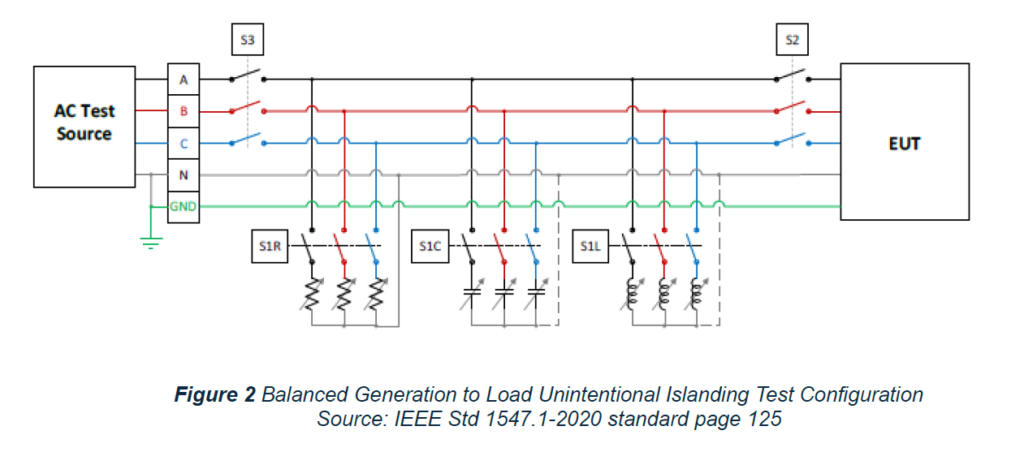
Unintentional Anti-Islanding Test Configuration

Download Appnote: The Fundamentals of Anti-Islanding Test Solutions

Grid Simulator with Anti-Islanding Test Solutions for Grid Compliance Testing

Learn how Pacific Power Source’s Grid Simulators‘ build-in RLC modes provide an all-in-1 solution for anti-islanding compliance testing.
This white paper provides a comprehensive overview of anti-islanding concepts, testing applications, methods, and equipment considerations, and compliance standards.
Anti-Islanding Testing

Our Solution: The All-in-1 AZX Series

Regenerative-AC-Source-with-PHIL-AZX-Series with PHIL

AZX Series – AC Power Source and Load with PHIL

The AZX Series optimized for PHIL applications. It has an interface via a low latency, per-phase analog input. This feature amplifies control signals from real-time simulation systems for PHIL testing.

 Key Features:

• Modular and Scalable Power

• Widest Operating Envelope

• Extra Current Availability 

• Built in Voltage, Current and Power Measurements

• Most Flexible Configuration

• 4-Q AC/DC Load Included

• CE Emulation Mode allows for accurate and effective anti-islanding testing with RLC modes. 

• Option P Available for Anti-Islanding Pre-Written Test Sequence


Summary

PHIL capability is available on the AZX Series All-in-1 AC/DC Power Source, and GSZ  Series Regenerative Grid Simulator.  For additional information, please contact sales@pacificpower.com.

The Fundamentals of Anti-Islanding Testing

What is Anti-Islanding?

Anti-islanding protection is essential for distributed energy resources (DERs) like solar inverters, battery storage, and Vehicle-to-Grid (V2G) systems in which energy is pushed back onto the grid. Unintentional islanding poses safety risks, including hazards to utility workers, equipment damage, and service disruptions.

As the demand for distributed energy resources (DERs) and electrification grows, ensuring safety and grid stability has become more critical than ever. One of the key safety mechanisms is anti-islanding protection—designed to prevent a solar inverter, for example, from continuing to feed power onto the grid when the grid has shut down.

Islanding occurs when a local energy generator continues to feed power into the grid during a grid outage, creating a hazardous “island” of energized equipment. Anti-islanding protection ensures that DERs or grid connected systems like EV chargers promptly disconnect from the grid during such events, safeguarding utility workers, customers, and equipment.

Testing for anti-islanding behavior is a mandatory requirement in compliance with standards like UL 1741 SA and IEEE 1547.1. Pacific Power Source’s AZX and GSZ Series grid simulators simplify this complex testing by providing a controlled, repeatable, and automated test environment that meets industry requirements

Why Does Testing for Anti-Islanding Matter?

Regulatory standards require grid connected devices to detect and shut down during grid loss scenarios within a specified time.
Traditional anti-islanding tests involve precise control of voltage, frequency, and phase imbalance.

The main objectives of anti-islanding include:

  • Protect utility personnel from unexpected live circuits.
  • Prevent damage to grid connected equipment due to voltage/frequency mismatch.
  • Comply with interconnection standards (IEEE 1547, IEC 62116, UL 1741 SA, SB) and relevant regional interconnection codes.

Key Applications 

Anti-islanding testing is mandatory for DERs that export power to the grid such as:

  • Solar PV Inverters
  • Bidirectional EV Chargers
  • Battery Energy Storage Systems (BESS)
  • Vehicle-to-Grid (V2G) / Vehicle-to-Everything (V2X) Systems
  • Microgrids with Grid-Tied Modes
  • Smart Inverters / Advanced Grid Support Inverters

Example Grid Simulator Unintentional Islanding Test Configuration

A typical anti-islanding test setup is designed to evaluate whether a grid-tied inverter or distributed energy resource (DER) can reliably detect and respond to a loss of grid connection—an event known as unintentional islanding.

A Typical Anti-Islanding Set-up

  • Grid simulator
  • A device under test (DUT)
  • Controllable RLC load bank
  • Measurement equipment

Together, these components replicate real-world scenarios in which the inverter must cease to energize an isolated section of the grid. This controlled environment allows for precise assessment of the inverter’s anti-islanding protection capabilities, as required by standards such as IEEE 1547, UL 1741, and IEC 62116.

Unintentional Anti-Islanding Test Configuration

Download Appnote: The Fundamentals of Anti-Islanding Test Solutions

Grid Simulator with Anti-Islanding Test Solutions for Grid Compliance Testing

Learn how Pacific Power Source’s Grid Simulators‘ build-in RLC modes provide an all-in-1 solution for anti-islanding compliance testing.

This white paper provides a comprehensive overview of anti-islanding concepts, testing applications, methods, and equipment considerations, and compliance standards.
Anti-Islanding Testing

Our Solution: The All-in-1 AZX Series

Regenerative-AC-Source-with-PHIL-AZX-Series with PHIL

AZX Series – AC Power Source and Load with PHIL

The AZX Series optimized for PHIL applications. It has an interface via a low latency, per-phase analog input. This feature amplifies control signals from real-time simulation systems for PHIL testing.

 Key Features:

• Modular and Scalable Power

• Widest Operating Envelope

• Extra Current Availability 

• Built in Voltage, Current and Power Measurements

• Most Flexible Configuration

• 4-Q AC/DC Load Included

• CE Emulation Mode allows for accurate and effective anti-islanding testing with RLC modes. 

• Option P Available for Anti-Islanding Pre-Written Test Sequence


Summary

PHIL capability is available on the AZX Series All-in-1 AC/DC Power Source, and GSZ  Series Regenerative Grid Simulator.  For additional information, please contact sales@pacificpower.com.